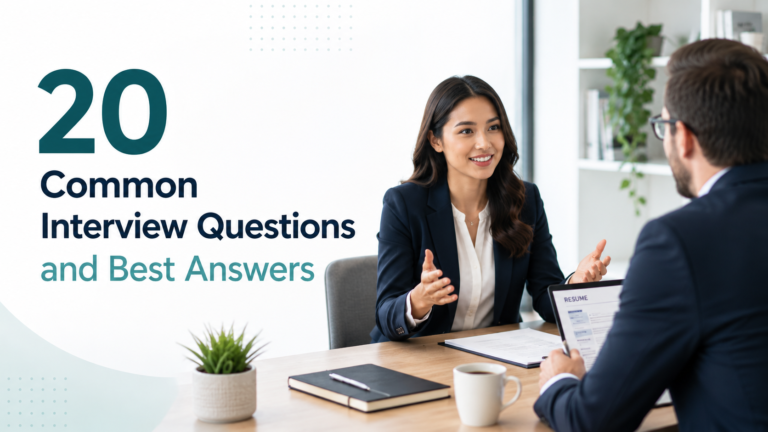
15 Interview Tips and Tricks to Help You Get Hired
A great resume can get you into the interview, but what happens next often determines whether you receive the job offer. These practical interview tips will help you prepare better, answer confidently, and make a stronger impression on hiring managers.
Getting invited to an interview means something in your application already worked. Your experience, skills, resume, or combination of all three convinced an employer that you might be a strong candidate.
Now you need to turn that initial interest into confidence that you can actually perform the job.
Strong interviewing is not about memorizing impressive answers. It is about understanding what the employer needs, preparing relevant evidence from your experience, and communicating that information clearly.
In This Guide
- Research the company
- Study the job description
- Prepare “Tell me about yourself”
- Use the STAR method
- Prepare career stories
- Practice strategically
- Keep answers focused
- Talk about achievements
- Handle weakness questions
- Ask smart questions
- Use confident body language
- Discuss previous employers carefully
- Prepare for salary questions
- Finish strongly
- Follow up after the interview
1. Research the Company Before the Interview
Walking into an interview without understanding the company is one of the easiest ways to appear unprepared.
You do not need to memorize the company’s entire history. Instead, focus on information that helps you understand what the organization does and how your potential role contributes to it.
- Review the company’s main products or services.
- Understand who its customers are.
- Read the About page and company mission.
- Look at recent announcements or important developments.
- Understand where your position fits into the business.
2. Study the Job Description Like an Interview Guide
The job description is one of the best clues you have about what the interviewer may ask.
Pay attention to skills, responsibilities, tools, and qualifications that appear several times. Repetition often indicates something the employer considers important.
If the description repeatedly mentions project management, customer communication, leadership, data analysis, or specific software, prepare examples that demonstrate those abilities.
If you are still preparing your application, read our ATS Resume Guides to understand how employers and Applicant Tracking Systems evaluate resumes before candidates reach the interview stage.
3. Prepare a Strong “Tell Me About Yourself” Answer
This question frequently appears near the beginning of an interview and can influence the direction of the entire conversation.
Avoid telling your complete personal history. Keep your answer relevant to your professional background and the position.
“I currently work in digital marketing with a focus on SEO and content strategy. Over the last few years, I have helped websites improve their organic visibility and increase qualified traffic. I am now looking for an opportunity where I can apply that experience within a larger marketing team and take responsibility for more strategic campaigns.”
4. Use the STAR Method for Behavioral Interview Questions
Questions beginning with “Tell me about a time…” are usually behavioral interview questions.
A simple way to answer them is the STAR method.
The result is particularly important. Numbers can make an answer much more convincing.
Examples include increasing revenue, reducing costs, improving customer satisfaction, completing a project early, increasing traffic, or saving time.
5. Prepare Five to Seven Strong Career Stories
Trying to predict every possible interview question is difficult. Preparing several flexible career stories is much easier.
Prepare examples involving:
- A difficult problem you solved.
- A successful project.
- A mistake and what you learned.
- A conflict you handled professionally.
- A time you demonstrated leadership.
- A situation involving a tight deadline.
- An achievement you are particularly proud of.
One strong story can often be adapted to answer several different interview questions.
6. Practice Your Answers Without Memorizing Them
Interview practice can significantly improve confidence, but memorizing entire paragraphs can make you sound unnatural.
Instead, remember the important points you want to communicate.
Practice answering questions aloud. Recording yourself on your phone can also reveal problems that are difficult to notice while speaking.
Listen for:
- Answers that are unnecessarily long.
- Repeated filler words.
- Speaking too quickly.
- Missing results or examples.
- Answers that never directly address the question.
7. Keep Your Interview Answers Focused
One common interview mistake is continuing to talk after the question has already been answered.
Start with a direct answer, provide relevant context, and stop when you have communicated the important information.
If the interviewer wants additional details, they can ask a follow-up question.
8. Discuss Achievements, Not Just Responsibilities
Employers want to understand what changed because of your work.
| Weak Answer | Stronger Answer |
|---|---|
| I managed social media accounts. | I managed five social accounts and helped increase monthly engagement by 35% within six months. |
| I handled customer support. | I handled customer support while helping reduce average response time and improving customer satisfaction. |
| I worked on SEO. | I led on-page SEO improvements that increased qualified organic traffic across priority landing pages. |
Responsibilities show what you were expected to do. Achievements show the value you actually created.
The same principle should appear in your resume. Read our guide to different resume types if you are deciding how to present your experience effectively.
9. Prepare for “What Is Your Greatest Weakness?”
Avoid cliché answers such as “I work too hard” or “I am a perfectionist” unless you can provide a genuine explanation.
Choose a real weakness that does not directly undermine your ability to perform the main responsibilities of the job.
Then explain what you are actively doing to improve.
“Earlier in my career, I sometimes spent too much time refining smaller details before completing the highest-priority work. I have improved this by defining deliverables and deadlines before starting a project and reviewing priorities at the beginning of each day.”
This approach demonstrates self-awareness rather than pretending you have no weaknesses.
10. Prepare Smart Questions for the Interviewer
Near the end of the interview, you will often hear:
“Do you have any questions for us?”
Prepare several thoughtful questions in advance.
- What would success look like in this role during the first six months?
- What are the biggest challenges someone in this position would face?
- How does the team measure performance?
- What qualities have made previous employees successful in this position?
- What are the team’s biggest priorities right now?
Good questions can turn the final part of an interview into a meaningful professional conversation.
11. Pay Attention to Your Body Language
Your answers are important, but communication also includes how you present yourself.
- Maintain natural eye contact.
- Sit comfortably but professionally.
- Avoid constantly looking down.
- Listen without interrupting.
- Keep your hands relaxed.
- Smile naturally when appropriate.
During video interviews, try to look toward the camera periodically instead of watching your own video throughout the conversation.
12. Never Turn the Interview Into a Complaint Session
You may have legitimate reasons for leaving a previous employer, but repeatedly criticizing former managers or coworkers can create a negative impression.
“My previous manager was terrible.”
Try:
“I reached a point where I wanted clearer growth opportunities and a more collaborative environment.”
Keep your explanation brief, professional, and focused on what you want next.
13. Prepare for Salary Questions Before the Interview
Do not wait until the interviewer asks about compensation before thinking about your answer.
Research salary ranges for your position, experience level, industry, and location.
“Based on the responsibilities of the position and my experience, I would expect a range of X to Y, although I am open to discussing the overall compensation package and responsibilities.”
Knowing your target range beforehand makes it much easier to respond calmly and professionally.
14. Finish the Interview Strongly
The final minutes of an interview provide another opportunity to reinforce why you are interested in the position.
You do not need an aggressive sales pitch. A short, confident statement can leave the interviewer with a clear understanding of your interest.
15. Send a Follow-Up Email After the Interview
A short thank-you email after the interview is a simple way to demonstrate professionalism and reinforce your interest.
Ideally, send it within approximately 24 hours.
Your message can include:
- A thank-you for the interviewer’s time.
- A brief reference to something discussed during the interview.
- A short reminder of why the opportunity interests you.
- A professional closing.
Quick Interview Preparation Checklist
| Before the Interview | Ready? |
|---|---|
| Research the company and its services | ✓ |
| Review the complete job description | ✓ |
| Prepare your “Tell me about yourself” answer | ✓ |
| Prepare 5–7 STAR stories | ✓ |
| Review measurable career achievements | ✓ |
| Prepare questions for the interviewer | ✓ |
| Research the expected salary range | ✓ |
| Test your camera and microphone for video interviews | ✓ |
Start With a Stronger Resume
Interview preparation begins before the interview itself. Explore professionally designed resume resources and templates created to help you present your experience clearly and confidently.
Explore Resume Templates →Frequently Asked Interview Questions
How should I prepare for a job interview?
Research the company, study the job description, prepare examples of your achievements, practice common questions, and prepare several questions to ask the interviewer.
How long should interview answers be?
There is no universal time limit, but many normal interview answers can be communicated clearly within approximately 45 seconds to two minutes. More complex behavioral questions may require additional detail.
What is the STAR method in interviews?
STAR stands for Situation, Task, Action, and Result. It is a structured method for answering behavioral questions using a specific example from your experience.
What should I ask at the end of an interview?
Ask questions about expectations, priorities, team culture, performance measurement, challenges, and what success would look like in the position.
Should I send an email after an interview?
A brief professional thank-you email within approximately 24 hours can reinforce your interest and provide a positive final touch after the interview.
Final Thoughts
Successful interviews are rarely about giving a perfect answer to every question.
Strong candidates prepare carefully, understand what the employer needs, communicate relevant examples, and make it easy for the interviewer to see how their experience connects to the position.
Research the company. Study the job description. Prepare strong career stories. Practice your answers. Use measurable achievements. Ask thoughtful questions.
Your resume may open the door, but a prepared and confident interview can help turn that opportunity into a job offer.
Continue exploring Resume Types, ATS Resume Tips, and Interview Tips & Tricks from Resume Polish Studio to strengthen every stage of your job search.