What Is the Best Resume Format for 2026?
For most candidates, the reverse-chronological format remains the strongest default.
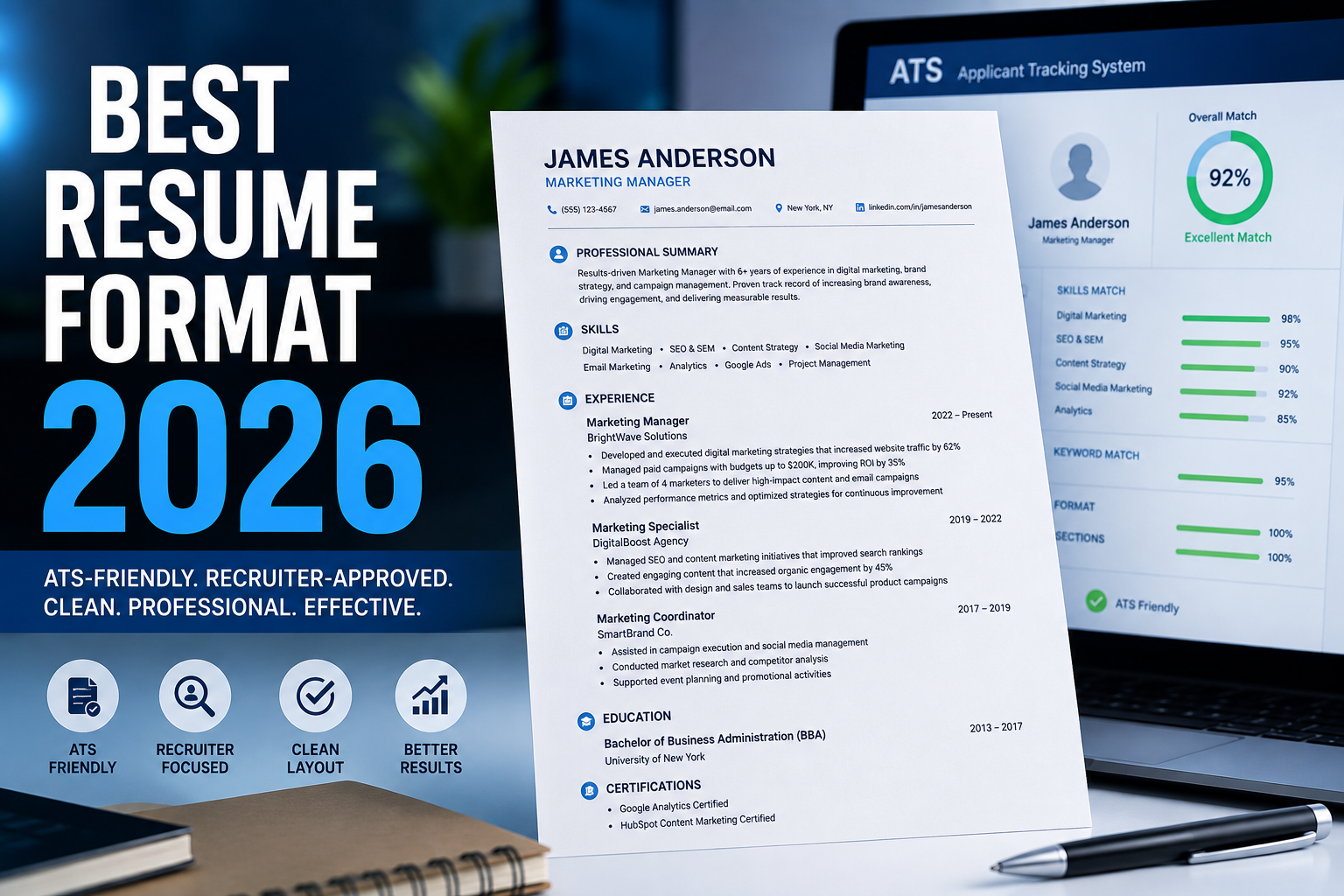
It places your most recent experience first and makes your career progression easy to understand. It is particularly effective when your recent jobs are relevant to the position you’re targeting. CareerOneStop and Microsoft both identify chronological resumes as a strong choice for candidates with established, relevant work histories.
A practical structure is:
- Name and contact information
- Professional Summary
- Skills
- Work Experience
- Education
- Projects, certifications, or other relevant sections
The order can change depending on your background. A recent graduate, for example, may place Education or Projects higher than an experienced professional would.
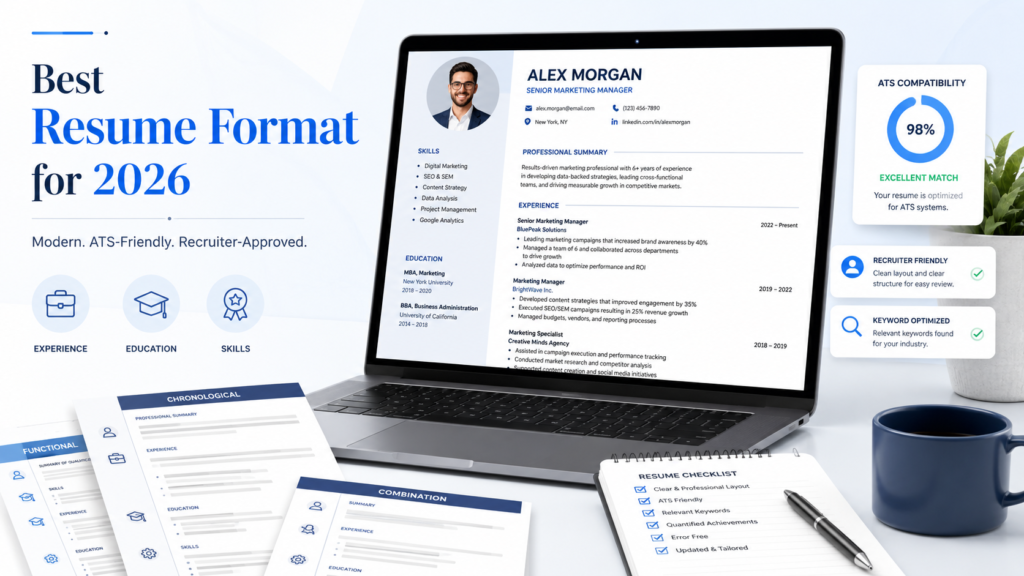
The Best Resume Layout for ATS in 2026
ATS compatibility is less about finding a magical template and more about making your document easy to parse.
A conservative layout is usually the safest:
- Single column
- Left-aligned text
- Standard section headings
- Consistent spacing
- Simple bullet points
- No unnecessary graphics
- No text boxes
- No decorative skill bars
- No important information hidden in headers or footers
CareerOneStop specifically recommends a simple, single-column layout and warns that tables, text boxes, logos, images, and graphics can cause problems with some ATS systems.
That does not mean every two-column resume automatically fails ATS. Different systems parse documents differently. The point is risk management: if you are applying through an unfamiliar system, a straightforward single-column layout minimizes unnecessary parsing problems.
If you’re unsure about your current design, [Read the ATS-Friendly Resume Guide].
Reverse Chronological vs. Combination vs. Functional
Your experience should determine the format rather than the other way around.
| Resume format | Best for | Main advantage | Main drawback |
|---|---|---|---|
| Reverse chronological | Established, relevant experience | Shows career progression clearly | Makes gaps more visible |
| Combination | Career changers or specialized professionals | Balances skills and experience | Can become longer |
| Functional | Limited or highly unusual work history | Emphasizes transferable skills | Can obscure employment history |
A reverse-chronological resume should be your default if you’ve been working consistently in the same field.
A combination resume can make more sense when your skills are highly relevant but your previous job titles don’t tell the complete story.
A functional resume is the most specialized option. It emphasizes capabilities rather than detailed employment history, but CareerOneStop notes that this format can be misinterpreted by employers and some ATS platforms.
What Font and Size Should You Use?
Your resume doesn’t need a trendy font. It needs to be readable.
Use a professional, widely available font such as:
- Arial
- Calibri
- Georgia
- Garamond
- Times New Roman
A 10–12 point body font is a practical range. Your name and major headings can be larger.
CareerOneStop recommends 10–12 point fonts and emphasizes consistency throughout the document.
Don’t shrink everything to 8-point text simply to force three pages of information onto one page. Cutting irrelevant content is usually better.
How Long Should a Resume Be in 2026?
For most applicants, one or two pages is appropriate.
Recent graduates and candidates with limited experience will usually benefit from one page. Professionals with substantial relevant experience can use two pages when the additional information genuinely strengthens the application.
The key isn’t hitting an arbitrary page count. Every section should earn its space.
Harvard’s career guidance similarly emphasizes concise organization, relevant information, and demonstrating results rather than simply filling the page.
PDF vs. DOCX: Which Resume File Type Is Best?
There is no universal winner.
Follow the employer’s instructions first. If the application requests PDF, submit PDF. If it requests Word, submit DOCX. The U.S. Department of Labor’s 2026 resume guidance explicitly recommends following the employer’s specified format and notes that both PDF and Word documents are commonly used.
If no format is specified, a text-based PDF can preserve your intended formatting, while DOCX can be useful for systems where Word documents are preferred.
Whatever you choose, avoid uploading a resume that is simply an image or scanned document.
Keywords Matter More Than Decorative Design
An ATS-friendly resume isn’t just visually simple. It should also contain the terminology relevant to the job.
Start with the job description. Identify important qualifications, tools, certifications, methodologies, and role-specific terminology that genuinely match your background.
Then incorporate those terms naturally into your:
- Professional Summary
- Skills section
- Work experience bullets
- Project descriptions
Don’t create a block of keywords solely for an ATS. A recruiter still needs to understand what you actually accomplished.
For example:
Weak:
“Responsible for SEO and website optimization.”
Stronger:
“Improved organic search visibility through technical SEO, keyword research, internal linking, and content optimization.”
The second version provides context rather than simply naming a skill.
What Should You Avoid on an ATS-Friendly Resume?
Some design elements create unnecessary risk without adding much value.
Avoid:
- Profile photos for standard U.S. applications
- Skill-rating graphics such as “SEO: 90%”
- Decorative icons replacing text
- Large colored backgrounds
- Complex tables
- Multiple text columns
- Important information inside headers or footers
- Unusual section names
- Excessive colors
- Dense paragraphs
Harvard also recommends avoiding photos, personal details such as age and gender, and unnecessary information while emphasizing clear, fact-based writing.
A clean resume can still look professional. Good typography, spacing, hierarchy, and alignment are enough.
A Simple 2026 Resume Formula
If you want a reliable starting point, use this structure:
YOUR NAME
City, State | Phone | Professional Email | LinkedIn
PROFESSIONAL SUMMARY
2–4 lines focused on your experience, specialization, and strongest relevant value.
SKILLS
Relevant technical and professional skills using terminology from the target job description.
PROFESSIONAL EXPERIENCE
Job Title — Company | Location | Dates
- Accomplishment + action + measurable result
- Relevant responsibility or achievement
- Relevant tool, skill, or outcome
EDUCATION
Degree — School | Graduation Year
ADDITIONAL SECTIONS
Certifications, projects, publications, awards, or volunteer experience only when relevant.
Before submitting, compare the document against the job description and remove anything that doesn’t help establish your fit.
You can also [Explore Editable ATS-Friendly Resume Templates] if you want a professionally structured starting point.
The Bottom Line
The best resume format for 2026 is usually a single-column, reverse-chronological resume with standard headings, readable typography, relevant keywords, and concise achievement-focused content.
Don’t optimize exclusively for ATS. Optimize for both parsing and human scanning. The ATS needs to extract your information correctly, while the recruiter needs to understand your qualifications quickly.
Your next step: take one target job description and rebuild your resume specifically around its genuinely relevant requirements rather than sending the same generic version everywhere.
FAQs
Is a two-column resume ATS-friendly in 2026?
A two-column resume can sometimes be parsed correctly, but parsing behavior varies between ATS platforms. A single-column layout is the safer choice when you don’t know which system an employer uses. It also gives recruiters a straightforward reading order.
Should I use a PDF or DOCX resume?
Use the file type requested by the employer. If no format is specified, either a properly structured DOCX or a text-based PDF can work. The U.S. Department of Labor recommends following the employer’s instructions rather than treating one format as universally superior.
Is reverse chronological still the best resume format?
Yes, for most candidates with relevant and reasonably consistent experience. It immediately shows recruiters your latest position and career progression. Career changers or candidates with unusual work histories may benefit from a combination format instead.
How many pages should a 2026 resume be?
One page is generally appropriate for students, recent graduates, and candidates with limited experience. Two pages can be appropriate for experienced professionals when the additional information is relevant. Avoid adding content merely to reach a particular page count.
What sections should every resume have?
Most resumes should include contact information, a professional summary or profile, skills, work experience, and education. Additional sections such as certifications, projects, or publications should be included when they strengthen your candidacy for the specific role.
Do ATS systems reject resumes with graphics?
You should not assume that every ATS rejects graphics. However, graphics, text boxes, tables, and complex layouts can make parsing less reliable on some systems. A simple text-based design reduces that risk, which is why it remains the safer default.